Conditional job offer? Do not hand in your notice yet
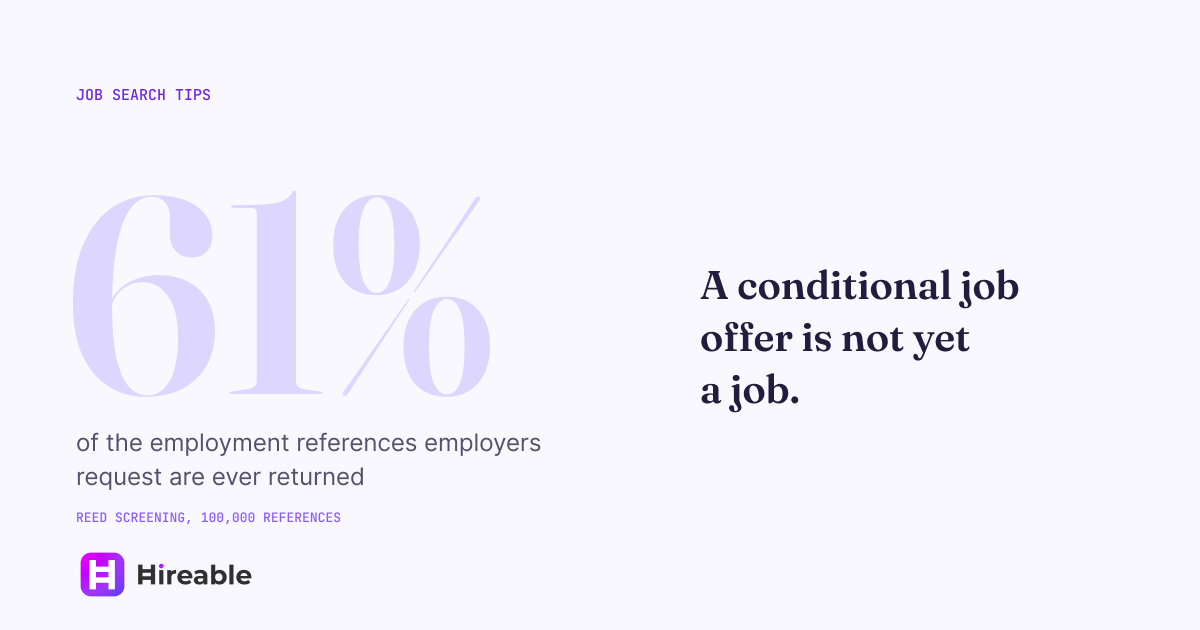
In Reed Screening research covering 100,000 employment references, only 61% of the references employers requested were ever returned, and 81% of those that did arrive contained nothing more than dates of employment (Reed, 2023). That number should change how you read the email sitting in your inbox. If your job offer says it is conditional on references, right to work checks or qualifications, the system it depends on leaves 39% of requests unanswered. A conditional job offer is not yet a job, and the safest rule in the whole of job searching follows from that. Do not hand in your notice until every condition on the offer has been met.
This comes up constantly on UK jobs forums, and the version posted on MoneySavingExpert last week is typical. An offer arrives, conditional on references and right to work. The agency recruiter, who has been asking since the first interview whether the month's notice could be squeezed to two weeks, wants a start date. The candidate is left holding the only real risk in the room, resigning from a paid job on the strength of a document that says, in plain terms, that it can still be taken back.
What a conditional job offer actually means
A conditional offer of employment is an offer that only becomes binding once you meet the conditions attached to it. Until then, gov.uk is blunt about your position. An employer can withdraw a conditional offer if the conditions are not met, and you have very little comeback. Once every condition is satisfied and the offer is confirmed as unconditional, withdrawing it becomes a breach of contract, which is why Acas advises employers to treat that line with care.
The usual conditions are references, right to work checks, qualification verification, and sometimes a DBS check or occupational health clearance. None of these are formalities you control. All of them can stall, arrive late, or come back with a surprise in them.
On a Mumsnet thread asking exactly this question, the settled advice was to wait for a signed contract and written confirmation that references and clearances are done. In a separate NHS thread, a recruiter confirmed they had withdrawn an offer after references and sickness records came back. Withdrawals are not a theoretical risk. They happen, and they happen at the exact moment you are most exposed.
The checks behind the offer fail more often than you would think
The uncomfortable truth about references is not that they might say something damaging. It is that they often never arrive at all. In Reed Screening's study of 100,000 references, only 61% were returned, and 65% of the referee details supplied by candidates were wrong. Of the references that did come back, most confirmed only employment dates, because many UK employers now give factual, dates-and-job-title references as a matter of policy.
Jobseekers have noticed. On the MoneySavingExpert thread, one regular's blunt verdict was that most employer references say almost nothing these days, if they show up at all.
That cuts both ways, and it is worth being precise about it. If you are nervous that a reference will torpedo your offer, the dates-only convention should reassure you. The genuine risk is delay. A reference that takes five weeks to arrive holds your offer in conditional limbo for five weeks, and every one of those weeks is a week you should still be employed somewhere.
When to hand in your notice
The clean answer is the one a long-standing forum poster gave, "Do nothing until you have an unconditional offer and all conditions are satisfied."
In practice, that means three things are in your hands before your resignation letter leaves them: Written confirmation that the offer is unconditional, a contract signed by both sides, and a start date agreed in writing. If the new employer wants you to start before the checks are complete, the question to put to them is simple and fair. What happens to my employment if a condition later fails? Some employers will confirm you start regardless and take the risk themselves. That answer, in writing, is nearly as good as an unconditional offer. Silence, or a vague reassurance from a third party, is not.
Two smaller traps from the same forum threads are worth flagging. Accrued holiday or time off in lieu does not automatically shorten your notice period. Your current employer decides whether you can use it that way, so check before you promise anyone an early start date. And your current employer's reaction to a resignation is theirs to choose. Some will hold you to every day of notice, and a few will walk you out the same morning, which matters if your new start date is still floating on incomplete checks.
If the recruiter is pushing you to start sooner
Recruiters are paid when you start, so a compressed timeline serves them and the hiring company. It does not serve you, because none of the risk of an early resignation lands on either of them. That does not make the recruiter an enemy. It makes them a negotiator for the other side, and you can respond in kind. Tell them you are delighted to accept, and that your notice goes in the day the offer is confirmed unconditional. A hiring company that wants you will not withdraw over that sentence. In the current market it is also a sentence worth saying calmly and early, with UK payrolled employment down 103,000 over the year to spring 2026 (ONS Labour market overview, June 2026). Walking out of a job you hold is a bigger decision than it was two years ago, so let the paperwork catch up with the enthusiasm before you do.
Your rights if a job offer is withdrawn
If the worst happens, the legal position depends entirely on which side of the conditional line you were standing on.
If the offer was still conditional and a condition was not met, the employer is generally entitled to withdraw it, and Citizens Advice explains there is usually little you can do, unless the real reason for withdrawal was discrimination connected to a protected characteristic, which is unlawful at any stage.
If the offer was unconditional, or every condition had already been satisfied, you have a contract. Withdrawing it is a breach, and you can claim damages. But here is the part most people find hardest to hear, and the reason this whole article argues for patience. Those damages are normally limited to your notice period under the new contract, often a week or a month's pay. Nobody compensates you for the job you resigned from. People discover this after the fact, like the caller to a legal advice line whose offer was rescinded after they had already quit their old role. The law offers a sticking plaster. Your notice-timing decision is the actual protection.
Before you write the resignation letter
Run down this list, and post the letter only when every line is true. The offer is confirmed unconditional in writing. The contract is signed by both sides. The start date is agreed and written down. You know what your current employer says about holiday during notice. Until then, keep applying and keep interviewing, because a pipeline is the best insurance policy a conditional offer can have.
This is also where Hireable earns its keep. Hireable keeps your search running while an offer works through its checks, tailoring your CV for each role, lining up interview practice, and applying on your behalf, so one wobbling offer never carries your whole next move. Get seen, get heard, get hired, and resign once, at the right moment.
Frequently asked questions
Can a job offer be withdrawn after I have accepted it?
Yes, if it is still conditional and a condition is not met. Once an offer is unconditional, or all conditions are satisfied, withdrawal is a breach of contract and you can claim damages, typically limited to the notice pay in the new contract.
Should I hand in my notice before my references are checked?
No. References are the condition most likely to stall, since Reed Screening found only 61% of requested references are ever returned. Wait for written confirmation that the offer is unconditional, or written confirmation that you will start regardless of outstanding checks.
What can I do if my job offer is withdrawn after I resigned?
Ask for the reason in writing, then check which side of the line you were on. Conditional and a condition failed, usually nothing, unless discrimination was involved. Unconditional, you can claim notice-period damages. Either way, ask your old employer about retracting your resignation quickly, and speak to Acas or Citizens Advice.
How long do pre-employment checks take?
Basic checks often complete inside two weeks, but references routinely take longer, and 78% of employers told Reed Screening that referencing is the slowest part of their hiring process. Enhanced DBS checks can run to several weeks on their own.